IL-9 Monoclonal Antibody (RM9A4), eFluor 660, eBioscience
PRODUCT DETAILS
Host: Rat
Isotype: IgG1, kappa
Clonality: Monoclonal
Clone: RM9A4
Format: eFluor 660
Reactivity: Ms
Application: Flow Cytometry
Tested Dilution: 0.06 µg/test
Concentration: 0.2 mg/mL
Storage: 4°C, store in dark, DO NOT FREEZE!
Formulation: PBS with 0.09% sodium azide; pH 7.2
Purification: Affinity chromatography
Data Sheet: TDS
Specific Information
Description: This monoclonal RM9A4 antibody reacts with mouse Interleukin-9 (IL-9). IL-9 is a 14 kDa cytokine originally named P40 and identified by its proliferative effects on T cell populations. The receptor, which is a heterodimer of the gamma chain portion of the IL-2 receptor and the IL-9R chain, activates Jak/STAT signaling pathways upon binding its ligand. Since the discovery of IL-9, numerous other functions have been observed. It induces Th17 and Treg differentiation in CD4+ T cells, IgE production in B cells, and the differentiation and proliferation of mast cells. IL-9 expression was initially observed in Th2 cells, but has since been found in Th17, eosinophil, and mast cells. Th9 cells, a newly discovered subset of CD4+ T cells, are characterized by the secretion of large amounts of IL-9 and IL-10. Th9 development is induced by stimulation of undifferentiated CD4+ with IL-4 and TGF beta. Th2 cells can also be driven towards a Th9 phenotype in the presence of TGF beta.
Applications Reported: This RM9A4 antibody has been reported for use in intracellular staining followed by flow cytometric analysis.
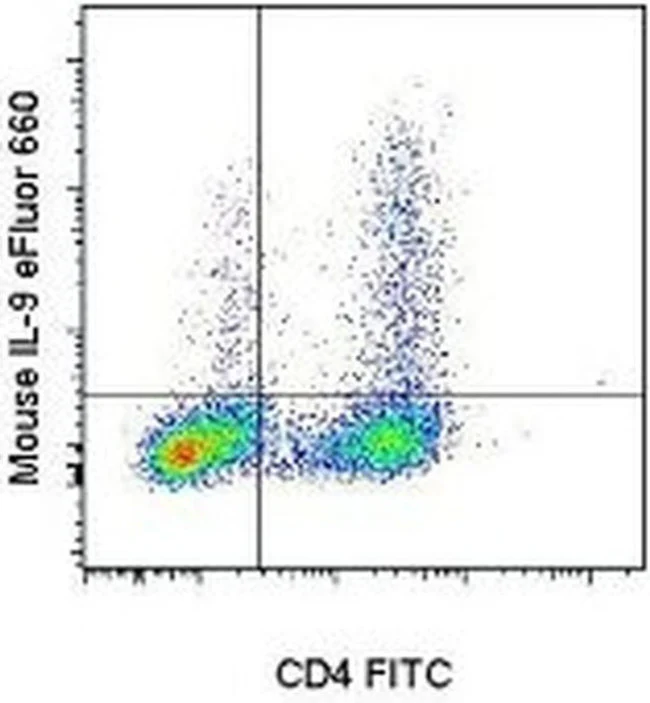
Applications Tested: This RM9A4 antibody has been tested by intracellular staining followed by flow cytometric analysis of cultured mouse splenocytes. This can be used at less than or equal to 0.06 µg per test. A test is defined as the amount (µg) of antibody that will stain a cell sample in a final volume of 100 µL. Cell number should be determined empirically but can range from 10^5 to 10^8 cells/test. It is recommended that the antibody be carefully titrated for optimal performance in the assay of interest.
eFluor® 660 is a replacement for Alexa Fluor® 647. eFluor® 660 emits at 659 nm and is excited with the red laser (633 nm). Please make sure that your instrument is capable of detecting this fluorochome.
Excitation: 633-647 nm; Emission: 668 nm; Laser: Red Laser.
Filtration: 0.2 µm post-manufacturing filtered.
For Research Use Only. Not for use in diagnostic procedures. Not for resale without express authorization.
Product Information
Product Information
Shipping & Returns
Shipping & Returns
IL-9 Monoclonal Antibody (RM9A4), eFluor 660, eBioscience
IL-9 Monoclonal Antibody (RM9A4), eFluor 660, eBioscience
PRODUCT DETAILS
Host: Rat
Isotype: IgG1, kappa
Clonality: Monoclonal
Clone: RM9A4
Format: eFluor 660
Reactivity: Ms
Application: Flow Cytometry
Tested Dilution: 0.06 µg/test
Concentration: 0.2 mg/mL
Storage: 4°C, store in dark, DO NOT FREEZE!
Formulation: PBS with 0.09% sodium azide; pH 7.2
Purification: Affinity chromatography
Data Sheet: TDS
Specific Information
Description: This monoclonal RM9A4 antibody reacts with mouse Interleukin-9 (IL-9). IL-9 is a 14 kDa cytokine originally named P40 and identified by its proliferative effects on T cell populations. The receptor, which is a heterodimer of the gamma chain portion of the IL-2 receptor and the IL-9R chain, activates Jak/STAT signaling pathways upon binding its ligand. Since the discovery of IL-9, numerous other functions have been observed. It induces Th17 and Treg differentiation in CD4+ T cells, IgE production in B cells, and the differentiation and proliferation of mast cells. IL-9 expression was initially observed in Th2 cells, but has since been found in Th17, eosinophil, and mast cells. Th9 cells, a newly discovered subset of CD4+ T cells, are characterized by the secretion of large amounts of IL-9 and IL-10. Th9 development is induced by stimulation of undifferentiated CD4+ with IL-4 and TGF beta. Th2 cells can also be driven towards a Th9 phenotype in the presence of TGF beta.
Applications Reported: This RM9A4 antibody has been reported for use in intracellular staining followed by flow cytometric analysis.
Applications Tested: This RM9A4 antibody has been tested by intracellular staining followed by flow cytometric analysis of cultured mouse splenocytes. This can be used at less than or equal to 0.06 µg per test. A test is defined as the amount (µg) of antibody that will stain a cell sample in a final volume of 100 µL. Cell number should be determined empirically but can range from 10^5 to 10^8 cells/test. It is recommended that the antibody be carefully titrated for optimal performance in the assay of interest.
eFluor® 660 is a replacement for Alexa Fluor® 647. eFluor® 660 emits at 659 nm and is excited with the red laser (633 nm). Please make sure that your instrument is capable of detecting this fluorochome.
Excitation: 633-647 nm; Emission: 668 nm; Laser: Red Laser.
Filtration: 0.2 µm post-manufacturing filtered.
For Research Use Only. Not for use in diagnostic procedures. Not for resale without express authorization.
Original: $455.00
-70%$455.00
$136.50Product Information
Product Information
Shipping & Returns
Shipping & Returns
Description
PRODUCT DETAILS
Host: Rat
Isotype: IgG1, kappa
Clonality: Monoclonal
Clone: RM9A4
Format: eFluor 660
Reactivity: Ms
Application: Flow Cytometry
Tested Dilution: 0.06 µg/test
Concentration: 0.2 mg/mL
Storage: 4°C, store in dark, DO NOT FREEZE!
Formulation: PBS with 0.09% sodium azide; pH 7.2
Purification: Affinity chromatography
Data Sheet: TDS
Specific Information
Description: This monoclonal RM9A4 antibody reacts with mouse Interleukin-9 (IL-9). IL-9 is a 14 kDa cytokine originally named P40 and identified by its proliferative effects on T cell populations. The receptor, which is a heterodimer of the gamma chain portion of the IL-2 receptor and the IL-9R chain, activates Jak/STAT signaling pathways upon binding its ligand. Since the discovery of IL-9, numerous other functions have been observed. It induces Th17 and Treg differentiation in CD4+ T cells, IgE production in B cells, and the differentiation and proliferation of mast cells. IL-9 expression was initially observed in Th2 cells, but has since been found in Th17, eosinophil, and mast cells. Th9 cells, a newly discovered subset of CD4+ T cells, are characterized by the secretion of large amounts of IL-9 and IL-10. Th9 development is induced by stimulation of undifferentiated CD4+ with IL-4 and TGF beta. Th2 cells can also be driven towards a Th9 phenotype in the presence of TGF beta.
Applications Reported: This RM9A4 antibody has been reported for use in intracellular staining followed by flow cytometric analysis.
Applications Tested: This RM9A4 antibody has been tested by intracellular staining followed by flow cytometric analysis of cultured mouse splenocytes. This can be used at less than or equal to 0.06 µg per test. A test is defined as the amount (µg) of antibody that will stain a cell sample in a final volume of 100 µL. Cell number should be determined empirically but can range from 10^5 to 10^8 cells/test. It is recommended that the antibody be carefully titrated for optimal performance in the assay of interest.
eFluor® 660 is a replacement for Alexa Fluor® 647. eFluor® 660 emits at 659 nm and is excited with the red laser (633 nm). Please make sure that your instrument is capable of detecting this fluorochome.
Excitation: 633-647 nm; Emission: 668 nm; Laser: Red Laser.
Filtration: 0.2 µm post-manufacturing filtered.
For Research Use Only. Not for use in diagnostic procedures. Not for resale without express authorization.