IL-1 beta (Pro-form) Monoclonal Antibody (NJTEN3), eFluor 450, eBioscience
PRODUCT DETAILS
Host: Rat
Isotype: IgG1, kappa
Clonality: Monoclonal
Clone: NJTEN3
Format: eFluor 450
Reactivity: Ms
Application: Flow Cytometry
Tested Dilution: 0.5 µg/test
Concentration: 0.2 mg/mL
Storage: 4°C, store in dark, DO NOT FREEZE!
Formulation: PBS with 0.09% sodium azide; pH 7.2
Purification: Affinity chromatography
Data Sheet: TDS
Specific Information
Description: This NJTEN3 monoclonal antibody reacts with the pro-form of mouse IL-1 beta, which is a proinflammatory cytokine expressed by monocytes, macrophages, and dendritic cells. It is synthesized in response to inflammatory stimuli as a 31 kDa inactive pro-form that accumulates in the cytosol. Cleavage of pro-IL-1 beta into the active 17 kDa protein requires the activation of inflammasomes, which are multi-protein complexes that respond to pathogens, stress conditions, and other danger signals. Inflammasome activation triggers the processing of the caspase-1 precursor into its active form, which in turn cleaves pro-IL-1 beta. IL-1 beta lacks a signal sequence peptide for classical ER/Golgi pathway and is instead secreted alongside caspase-1 via an alternate and incompletely understood mechanism. IL-1 beta signals via the IL-1RI, which is shared with IL-1 alpha. These cytokines play important roles in innate host defense by triggering the production of other proinflammatory cytokines in target cells and initiating acute-phase responses. Their activity can be moderated by IL-1 Receptor Antagonist (IL-1RA), a protein produced by many cell types that blocks receptor binding through competitive inhibition. Elevated levels of IL-1 beta have been associated with many chronic inflammatory conditions, giving IL-RA or IL-1 beta neutralizing antibodies potential therapeutical value. The NJTEN3 antibody recognizes only the pro-form of mouse IL-1 beta and does not see the active (cleaved) form.
Applications Reported: This NJTEN3 antibody has been reported for use intracellular staining followed by flow cytometric analysis.
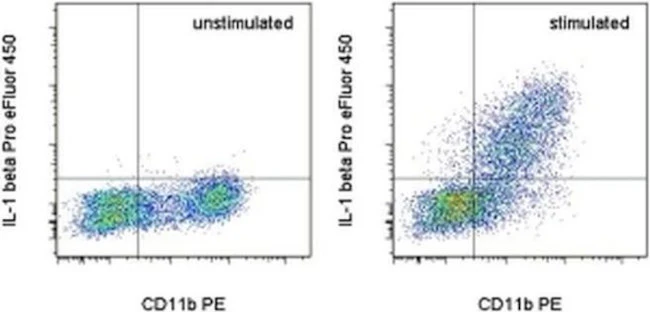
Applications Tested: This NJTEN3 antibody has been tested by intracellular staining of stimulated mouse thioglycolate-elicited peritoneal macrophages using the Intracellular Fixation & Permeabilization Buffer Set (Product # 88-8824-00) and protocol. Please refer to BestProtocols®: Protocol A: Two step protocol for (cytoplasmic) intracellular proteins. This can be used at less than or equal to 0.5 µg per test. A test is defined as the amount (µg) of antibody that will stain a cell sample in a final volume of 100 µL. Cell number should be determined empirically but can range from 10^5 to 10^8 cells/test. It is recommended that the antibody be carefully titrated for optimal performance in the assay of interest.
eFluor® 450 is an alternative to Pacific Blue®. eFluor® 450 emits at 445 nm and is excited with the Violet laser (405 nm). Please make sure that your instrument is capable of detecting this fluorochrome.
Excitation: 405 nm; Emission: 445 nm; Laser: Violet Laser.
Filtration: 0.2 µm post-manufacturing filtered.
For Research Use Only. Not for use in diagnostic procedures. Not for resale without express authorization.
Product Information
Product Information
Shipping & Returns
Shipping & Returns
IL-1 beta (Pro-form) Monoclonal Antibody (NJTEN3), eFluor 450, eBioscience
IL-1 beta (Pro-form) Monoclonal Antibody (NJTEN3), eFluor 450, eBioscience
PRODUCT DETAILS
Host: Rat
Isotype: IgG1, kappa
Clonality: Monoclonal
Clone: NJTEN3
Format: eFluor 450
Reactivity: Ms
Application: Flow Cytometry
Tested Dilution: 0.5 µg/test
Concentration: 0.2 mg/mL
Storage: 4°C, store in dark, DO NOT FREEZE!
Formulation: PBS with 0.09% sodium azide; pH 7.2
Purification: Affinity chromatography
Data Sheet: TDS
Specific Information
Description: This NJTEN3 monoclonal antibody reacts with the pro-form of mouse IL-1 beta, which is a proinflammatory cytokine expressed by monocytes, macrophages, and dendritic cells. It is synthesized in response to inflammatory stimuli as a 31 kDa inactive pro-form that accumulates in the cytosol. Cleavage of pro-IL-1 beta into the active 17 kDa protein requires the activation of inflammasomes, which are multi-protein complexes that respond to pathogens, stress conditions, and other danger signals. Inflammasome activation triggers the processing of the caspase-1 precursor into its active form, which in turn cleaves pro-IL-1 beta. IL-1 beta lacks a signal sequence peptide for classical ER/Golgi pathway and is instead secreted alongside caspase-1 via an alternate and incompletely understood mechanism. IL-1 beta signals via the IL-1RI, which is shared with IL-1 alpha. These cytokines play important roles in innate host defense by triggering the production of other proinflammatory cytokines in target cells and initiating acute-phase responses. Their activity can be moderated by IL-1 Receptor Antagonist (IL-1RA), a protein produced by many cell types that blocks receptor binding through competitive inhibition. Elevated levels of IL-1 beta have been associated with many chronic inflammatory conditions, giving IL-RA or IL-1 beta neutralizing antibodies potential therapeutical value. The NJTEN3 antibody recognizes only the pro-form of mouse IL-1 beta and does not see the active (cleaved) form.
Applications Reported: This NJTEN3 antibody has been reported for use intracellular staining followed by flow cytometric analysis.
Applications Tested: This NJTEN3 antibody has been tested by intracellular staining of stimulated mouse thioglycolate-elicited peritoneal macrophages using the Intracellular Fixation & Permeabilization Buffer Set (Product # 88-8824-00) and protocol. Please refer to BestProtocols®: Protocol A: Two step protocol for (cytoplasmic) intracellular proteins. This can be used at less than or equal to 0.5 µg per test. A test is defined as the amount (µg) of antibody that will stain a cell sample in a final volume of 100 µL. Cell number should be determined empirically but can range from 10^5 to 10^8 cells/test. It is recommended that the antibody be carefully titrated for optimal performance in the assay of interest.
eFluor® 450 is an alternative to Pacific Blue®. eFluor® 450 emits at 445 nm and is excited with the Violet laser (405 nm). Please make sure that your instrument is capable of detecting this fluorochrome.
Excitation: 405 nm; Emission: 445 nm; Laser: Violet Laser.
Filtration: 0.2 µm post-manufacturing filtered.
For Research Use Only. Not for use in diagnostic procedures. Not for resale without express authorization.
Original: $452.00
-70%$452.00
$135.60Product Information
Product Information
Shipping & Returns
Shipping & Returns
Description
PRODUCT DETAILS
Host: Rat
Isotype: IgG1, kappa
Clonality: Monoclonal
Clone: NJTEN3
Format: eFluor 450
Reactivity: Ms
Application: Flow Cytometry
Tested Dilution: 0.5 µg/test
Concentration: 0.2 mg/mL
Storage: 4°C, store in dark, DO NOT FREEZE!
Formulation: PBS with 0.09% sodium azide; pH 7.2
Purification: Affinity chromatography
Data Sheet: TDS
Specific Information
Description: This NJTEN3 monoclonal antibody reacts with the pro-form of mouse IL-1 beta, which is a proinflammatory cytokine expressed by monocytes, macrophages, and dendritic cells. It is synthesized in response to inflammatory stimuli as a 31 kDa inactive pro-form that accumulates in the cytosol. Cleavage of pro-IL-1 beta into the active 17 kDa protein requires the activation of inflammasomes, which are multi-protein complexes that respond to pathogens, stress conditions, and other danger signals. Inflammasome activation triggers the processing of the caspase-1 precursor into its active form, which in turn cleaves pro-IL-1 beta. IL-1 beta lacks a signal sequence peptide for classical ER/Golgi pathway and is instead secreted alongside caspase-1 via an alternate and incompletely understood mechanism. IL-1 beta signals via the IL-1RI, which is shared with IL-1 alpha. These cytokines play important roles in innate host defense by triggering the production of other proinflammatory cytokines in target cells and initiating acute-phase responses. Their activity can be moderated by IL-1 Receptor Antagonist (IL-1RA), a protein produced by many cell types that blocks receptor binding through competitive inhibition. Elevated levels of IL-1 beta have been associated with many chronic inflammatory conditions, giving IL-RA or IL-1 beta neutralizing antibodies potential therapeutical value. The NJTEN3 antibody recognizes only the pro-form of mouse IL-1 beta and does not see the active (cleaved) form.
Applications Reported: This NJTEN3 antibody has been reported for use intracellular staining followed by flow cytometric analysis.
Applications Tested: This NJTEN3 antibody has been tested by intracellular staining of stimulated mouse thioglycolate-elicited peritoneal macrophages using the Intracellular Fixation & Permeabilization Buffer Set (Product # 88-8824-00) and protocol. Please refer to BestProtocols®: Protocol A: Two step protocol for (cytoplasmic) intracellular proteins. This can be used at less than or equal to 0.5 µg per test. A test is defined as the amount (µg) of antibody that will stain a cell sample in a final volume of 100 µL. Cell number should be determined empirically but can range from 10^5 to 10^8 cells/test. It is recommended that the antibody be carefully titrated for optimal performance in the assay of interest.
eFluor® 450 is an alternative to Pacific Blue®. eFluor® 450 emits at 445 nm and is excited with the Violet laser (405 nm). Please make sure that your instrument is capable of detecting this fluorochrome.
Excitation: 405 nm; Emission: 445 nm; Laser: Violet Laser.
Filtration: 0.2 µm post-manufacturing filtered.
For Research Use Only. Not for use in diagnostic procedures. Not for resale without express authorization.