CD49c (Integrin alpha 3) Monoclonal Antibody (P1B5), APC, eBioscience
PRODUCT DETAILS
Host: Mouse
Isotype: IgG1
Clonality: Monoclonal
Clone: P1B5
Format: APC
Reactivity: Hu
Application: Flow Cytometry
Tested Dilution: 5 µL (0.125 µg)/test
Concentration: 5 μL/Test
Storage: 4°C, store in dark, DO NOT FREEZE!
Formulation: PBS with BSA and 0.09% sodium azide; pH 7.2
Purification: Affinity chromatography
Data Sheet: TDS
Specific Information
Description: This P1B5 monoclonal antibody reacts with human CD49c (also known as Integrin alpha 3). Integrins constitute a family of cell surface receptors that mediate adhesion between cells or between a cell and the extracellular matrix. These proteins are heterodimers consisting of two distinct subunits, alpha and beta. Integrins are expressed on hematopoietic, non-hematopoietic, and cancer cells. Integrin-mediated adhesion is regulated by changes in ligand affinity (or activation), cell shape, and integrin clustering and diffusion. Integrin alpha 3 forms a complex with the common beta 1 subunit to form the alpha3beta1 integrin. Studies have demonstrated the involvement of this integrin in wound healing and epithelial migration.
The P1B5 monoclonal antibody has been reported to affect adhesion to type I and VI collagens, as well as fibronectin and laminin.
Applications Reported: This P1B5 antibody has been reported for use in flow cytometric analysis.
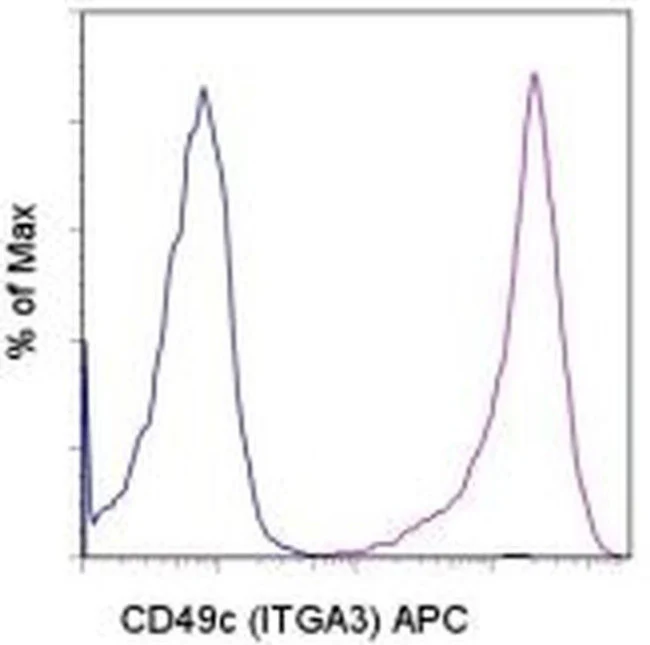
Applications Tested: This P1B5 antibody has been pre-titrated and tested by flow cytometric analysis of HeLa cells. This can be used at 5 µL (0.125 µg) per test. A test is defined as the amount (µg) of antibody that will stain a cell sample in a final volume of 100 µL. Cell number should be determined empirically but can range from 10^5 to 10^8 cells/test.
Excitation: 633-647 nm; Emission: 660 nm; Laser: Red Laser.
Filtration: 0.2 µm post-manufacturing filtered.
For Research Use Only. Not for use in diagnostic procedures. Not for resale without express authorization.
Product Information
Product Information
Shipping & Returns
Shipping & Returns
CD49c (Integrin alpha 3) Monoclonal Antibody (P1B5), APC, eBioscience
CD49c (Integrin alpha 3) Monoclonal Antibody (P1B5), APC, eBioscience
PRODUCT DETAILS
Host: Mouse
Isotype: IgG1
Clonality: Monoclonal
Clone: P1B5
Format: APC
Reactivity: Hu
Application: Flow Cytometry
Tested Dilution: 5 µL (0.125 µg)/test
Concentration: 5 μL/Test
Storage: 4°C, store in dark, DO NOT FREEZE!
Formulation: PBS with BSA and 0.09% sodium azide; pH 7.2
Purification: Affinity chromatography
Data Sheet: TDS
Specific Information
Description: This P1B5 monoclonal antibody reacts with human CD49c (also known as Integrin alpha 3). Integrins constitute a family of cell surface receptors that mediate adhesion between cells or between a cell and the extracellular matrix. These proteins are heterodimers consisting of two distinct subunits, alpha and beta. Integrins are expressed on hematopoietic, non-hematopoietic, and cancer cells. Integrin-mediated adhesion is regulated by changes in ligand affinity (or activation), cell shape, and integrin clustering and diffusion. Integrin alpha 3 forms a complex with the common beta 1 subunit to form the alpha3beta1 integrin. Studies have demonstrated the involvement of this integrin in wound healing and epithelial migration.
The P1B5 monoclonal antibody has been reported to affect adhesion to type I and VI collagens, as well as fibronectin and laminin.
Applications Reported: This P1B5 antibody has been reported for use in flow cytometric analysis.
Applications Tested: This P1B5 antibody has been pre-titrated and tested by flow cytometric analysis of HeLa cells. This can be used at 5 µL (0.125 µg) per test. A test is defined as the amount (µg) of antibody that will stain a cell sample in a final volume of 100 µL. Cell number should be determined empirically but can range from 10^5 to 10^8 cells/test.
Excitation: 633-647 nm; Emission: 660 nm; Laser: Red Laser.
Filtration: 0.2 µm post-manufacturing filtered.
For Research Use Only. Not for use in diagnostic procedures. Not for resale without express authorization.
Original: $383.00
-70%$383.00
$114.90Product Information
Product Information
Shipping & Returns
Shipping & Returns
Description
PRODUCT DETAILS
Host: Mouse
Isotype: IgG1
Clonality: Monoclonal
Clone: P1B5
Format: APC
Reactivity: Hu
Application: Flow Cytometry
Tested Dilution: 5 µL (0.125 µg)/test
Concentration: 5 μL/Test
Storage: 4°C, store in dark, DO NOT FREEZE!
Formulation: PBS with BSA and 0.09% sodium azide; pH 7.2
Purification: Affinity chromatography
Data Sheet: TDS
Specific Information
Description: This P1B5 monoclonal antibody reacts with human CD49c (also known as Integrin alpha 3). Integrins constitute a family of cell surface receptors that mediate adhesion between cells or between a cell and the extracellular matrix. These proteins are heterodimers consisting of two distinct subunits, alpha and beta. Integrins are expressed on hematopoietic, non-hematopoietic, and cancer cells. Integrin-mediated adhesion is regulated by changes in ligand affinity (or activation), cell shape, and integrin clustering and diffusion. Integrin alpha 3 forms a complex with the common beta 1 subunit to form the alpha3beta1 integrin. Studies have demonstrated the involvement of this integrin in wound healing and epithelial migration.
The P1B5 monoclonal antibody has been reported to affect adhesion to type I and VI collagens, as well as fibronectin and laminin.
Applications Reported: This P1B5 antibody has been reported for use in flow cytometric analysis.
Applications Tested: This P1B5 antibody has been pre-titrated and tested by flow cytometric analysis of HeLa cells. This can be used at 5 µL (0.125 µg) per test. A test is defined as the amount (µg) of antibody that will stain a cell sample in a final volume of 100 µL. Cell number should be determined empirically but can range from 10^5 to 10^8 cells/test.
Excitation: 633-647 nm; Emission: 660 nm; Laser: Red Laser.
Filtration: 0.2 µm post-manufacturing filtered.
For Research Use Only. Not for use in diagnostic procedures. Not for resale without express authorization.