CD363 (S1PR1) Monoclonal Antibody (SW4GYPP), eFluor 660, eBioscience
PRODUCT DETAILS
Host: Mouse
Isotype: IgG1, kappa
Clonality: Monoclonal
Clone: SW4GYPP
Format: eFluor 660
Reactivity: Hu
Application: Flow Cytometry
Tested Dilution: 5 µL (0.5 µg)/test
Concentration: 5 μL/Test
Storage: 4°C, store in dark, DO NOT FREEZE!
Formulation: PBS with BSA and 0.09% sodium azide; pH 7.2
Purification: Affinity chromatography
Data Sheet: TDS
Specific Information
Description: The SW4GYPP monoclonal antibody recognizes human CD363, also known as sphingosine-1-phosphate receptor 1 (S1PR1, S1P1), or endothelial differentiation G-protein coupled receptor 1 (EDG1). CD363 is a part of a family of five G-protein-coupled receptors that bind sphingosine-1-phosphate (S1P), a lysophospholipid mediator. It has been shown to be primarily expressed by lymphocytes but is also seen on endothelial cells, B cells, NK cells, monocytes/macrophages, neural progenitors, neurons, astrocytes, and oligodendrocytes. CD363 surface expression is dependent on the extracellular concentration of S1P and its signaling is important for lymphocyte egress from secondary lymphoid tissues and the thymus. CD363 plays a key role in many cellular processes like angiogenesis, vascular maturation, endothelial barrier function and trafficking of immune cells. Therapeutic CD363 modulators have been successful in the treatment of relapsing-remitting multiple sclerosis through sequestration of immune cells in secondary lymphoid organs and, therefore, away from sites of inflammation.
Applications Reported: This SW4GYPP antibody has been reported for use in flow cytometric analysis.
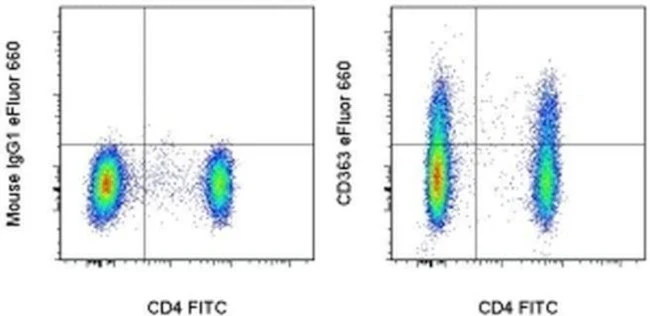
Applications Tested: This SW4GYPP antibody has been pre-titrated and tested by flow cytometric analysis of normal human peripheral blood cells. This can be used at 5 µL (0.5 µg) per test. A test is defined as the amount (µg) of antibody that will stain a cell sample in a final volume of 100 µL. Cell number should be determined empirically but can range from 10^5 to 10^8 cells/test.
eFluor® 660 is a replacement for Alexa Fluor® 647. eFluor® 660 emits at 659 nm and is excited with the red laser (633 nm). Please make sure that your instrument is capable of detecting this fluorochome.
Excitation: 633-647 nm; Emission: 668 nm; Laser: Red Laser.
Filtration: 0.2 µm post-manufacturing filtered.
For Research Use Only. Not for use in diagnostic procedures. Not for resale without express authorization.
Product Information
Product Information
Shipping & Returns
Shipping & Returns
CD363 (S1PR1) Monoclonal Antibody (SW4GYPP), eFluor 660, eBioscience
CD363 (S1PR1) Monoclonal Antibody (SW4GYPP), eFluor 660, eBioscience
PRODUCT DETAILS
Host: Mouse
Isotype: IgG1, kappa
Clonality: Monoclonal
Clone: SW4GYPP
Format: eFluor 660
Reactivity: Hu
Application: Flow Cytometry
Tested Dilution: 5 µL (0.5 µg)/test
Concentration: 5 μL/Test
Storage: 4°C, store in dark, DO NOT FREEZE!
Formulation: PBS with BSA and 0.09% sodium azide; pH 7.2
Purification: Affinity chromatography
Data Sheet: TDS
Specific Information
Description: The SW4GYPP monoclonal antibody recognizes human CD363, also known as sphingosine-1-phosphate receptor 1 (S1PR1, S1P1), or endothelial differentiation G-protein coupled receptor 1 (EDG1). CD363 is a part of a family of five G-protein-coupled receptors that bind sphingosine-1-phosphate (S1P), a lysophospholipid mediator. It has been shown to be primarily expressed by lymphocytes but is also seen on endothelial cells, B cells, NK cells, monocytes/macrophages, neural progenitors, neurons, astrocytes, and oligodendrocytes. CD363 surface expression is dependent on the extracellular concentration of S1P and its signaling is important for lymphocyte egress from secondary lymphoid tissues and the thymus. CD363 plays a key role in many cellular processes like angiogenesis, vascular maturation, endothelial barrier function and trafficking of immune cells. Therapeutic CD363 modulators have been successful in the treatment of relapsing-remitting multiple sclerosis through sequestration of immune cells in secondary lymphoid organs and, therefore, away from sites of inflammation.
Applications Reported: This SW4GYPP antibody has been reported for use in flow cytometric analysis.
Applications Tested: This SW4GYPP antibody has been pre-titrated and tested by flow cytometric analysis of normal human peripheral blood cells. This can be used at 5 µL (0.5 µg) per test. A test is defined as the amount (µg) of antibody that will stain a cell sample in a final volume of 100 µL. Cell number should be determined empirically but can range from 10^5 to 10^8 cells/test.
eFluor® 660 is a replacement for Alexa Fluor® 647. eFluor® 660 emits at 659 nm and is excited with the red laser (633 nm). Please make sure that your instrument is capable of detecting this fluorochome.
Excitation: 633-647 nm; Emission: 668 nm; Laser: Red Laser.
Filtration: 0.2 µm post-manufacturing filtered.
For Research Use Only. Not for use in diagnostic procedures. Not for resale without express authorization.
Product Information
Product Information
Shipping & Returns
Shipping & Returns
Description
PRODUCT DETAILS
Host: Mouse
Isotype: IgG1, kappa
Clonality: Monoclonal
Clone: SW4GYPP
Format: eFluor 660
Reactivity: Hu
Application: Flow Cytometry
Tested Dilution: 5 µL (0.5 µg)/test
Concentration: 5 μL/Test
Storage: 4°C, store in dark, DO NOT FREEZE!
Formulation: PBS with BSA and 0.09% sodium azide; pH 7.2
Purification: Affinity chromatography
Data Sheet: TDS
Specific Information
Description: The SW4GYPP monoclonal antibody recognizes human CD363, also known as sphingosine-1-phosphate receptor 1 (S1PR1, S1P1), or endothelial differentiation G-protein coupled receptor 1 (EDG1). CD363 is a part of a family of five G-protein-coupled receptors that bind sphingosine-1-phosphate (S1P), a lysophospholipid mediator. It has been shown to be primarily expressed by lymphocytes but is also seen on endothelial cells, B cells, NK cells, monocytes/macrophages, neural progenitors, neurons, astrocytes, and oligodendrocytes. CD363 surface expression is dependent on the extracellular concentration of S1P and its signaling is important for lymphocyte egress from secondary lymphoid tissues and the thymus. CD363 plays a key role in many cellular processes like angiogenesis, vascular maturation, endothelial barrier function and trafficking of immune cells. Therapeutic CD363 modulators have been successful in the treatment of relapsing-remitting multiple sclerosis through sequestration of immune cells in secondary lymphoid organs and, therefore, away from sites of inflammation.
Applications Reported: This SW4GYPP antibody has been reported for use in flow cytometric analysis.
Applications Tested: This SW4GYPP antibody has been pre-titrated and tested by flow cytometric analysis of normal human peripheral blood cells. This can be used at 5 µL (0.5 µg) per test. A test is defined as the amount (µg) of antibody that will stain a cell sample in a final volume of 100 µL. Cell number should be determined empirically but can range from 10^5 to 10^8 cells/test.
eFluor® 660 is a replacement for Alexa Fluor® 647. eFluor® 660 emits at 659 nm and is excited with the red laser (633 nm). Please make sure that your instrument is capable of detecting this fluorochome.
Excitation: 633-647 nm; Emission: 668 nm; Laser: Red Laser.
Filtration: 0.2 µm post-manufacturing filtered.
For Research Use Only. Not for use in diagnostic procedures. Not for resale without express authorization.