CD326 (EpCAM) Monoclonal Antibody (MH99), Alexa Fluor 488, eBioscience
PRODUCT DETAILS
Host: Mouse
Isotype: IgG2a, kappa
Clonality: Monoclonal
Clone: MH99
Format: Alexa Fluor 488
Reactivity: Hu
Application: Flow Cytometry
Tested Dilution: 5 µL (0.5 µg)/test
Concentration: 5 μL/Test
Storage: 4°C, store in dark, DO NOT FREEZE!
Formulation: PBS with BSA and 0.09% sodium azide; pH 7.2
Purification: Affinity chromatography
Data Sheet: TDS
Specific Information
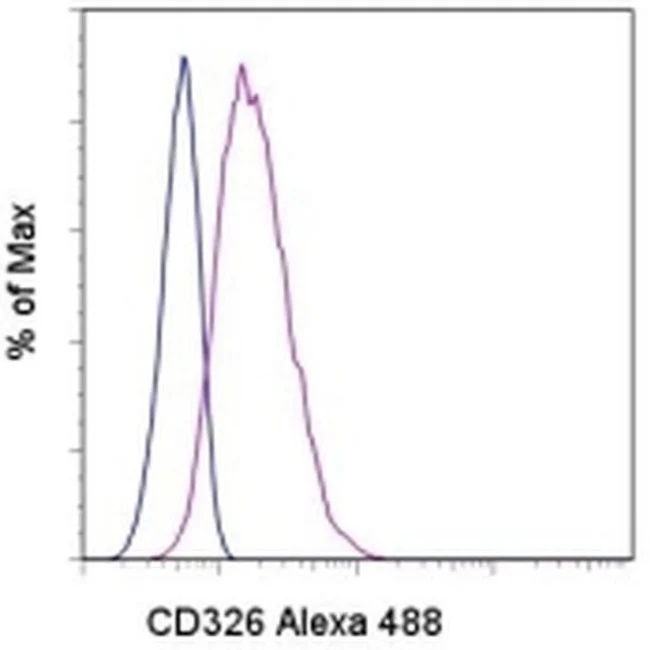
Description: The monoclonal antibody MH99 recognizes human CD326 also known as EpCAM (Epithelial cell adhesion molecule). This 40 kDa type I transmembrane protein is involved in cell-cell interactions in a calcium-independent manner. EpCAM is expressed primarily on the basolateral surface of most epithelia. Although normal epithelia express low levels of CD326, increased expression has been correlated with increased proliferation and progression to a mesenchymal phenotype. CD326 has also been used as a diagnostic marker on circulating metastatic carcinoma cells, while cancer cells of non-epithelial origin do not express EpCAM.
Based on crossblocking studies, MH99 and 1B7 see overlapping epitopes.
Applications Reported: This MH99 antibody has been reported for use in flow cytometric analysis.
Applications Tested: This MH99 antibody has been pre-titrated and tested by flow cytometric analysis of the A549 cell line. This can be used at 5 µL (0.5 µg) per test. A test is defined as the amount (µg) of antibody that will stain a cell sample in a final volume of 100 µL. Cell number should be determined empirically but can range from 10^5 to 10^8 cells/test.
Excitation: 488 nm; Emission: 519 nm; Laser: Blue Laser.
Filtration: 0.2 µm post-manufacturing filtered.
For Research Use Only. Not for use in diagnostic procedures. Not for resale without express authorization.
Product Information
Product Information
Shipping & Returns
Shipping & Returns
CD326 (EpCAM) Monoclonal Antibody (MH99), Alexa Fluor 488, eBioscience
CD326 (EpCAM) Monoclonal Antibody (MH99), Alexa Fluor 488, eBioscience
PRODUCT DETAILS
Host: Mouse
Isotype: IgG2a, kappa
Clonality: Monoclonal
Clone: MH99
Format: Alexa Fluor 488
Reactivity: Hu
Application: Flow Cytometry
Tested Dilution: 5 µL (0.5 µg)/test
Concentration: 5 μL/Test
Storage: 4°C, store in dark, DO NOT FREEZE!
Formulation: PBS with BSA and 0.09% sodium azide; pH 7.2
Purification: Affinity chromatography
Data Sheet: TDS
Specific Information
Description: The monoclonal antibody MH99 recognizes human CD326 also known as EpCAM (Epithelial cell adhesion molecule). This 40 kDa type I transmembrane protein is involved in cell-cell interactions in a calcium-independent manner. EpCAM is expressed primarily on the basolateral surface of most epithelia. Although normal epithelia express low levels of CD326, increased expression has been correlated with increased proliferation and progression to a mesenchymal phenotype. CD326 has also been used as a diagnostic marker on circulating metastatic carcinoma cells, while cancer cells of non-epithelial origin do not express EpCAM.
Based on crossblocking studies, MH99 and 1B7 see overlapping epitopes.
Applications Reported: This MH99 antibody has been reported for use in flow cytometric analysis.
Applications Tested: This MH99 antibody has been pre-titrated and tested by flow cytometric analysis of the A549 cell line. This can be used at 5 µL (0.5 µg) per test. A test is defined as the amount (µg) of antibody that will stain a cell sample in a final volume of 100 µL. Cell number should be determined empirically but can range from 10^5 to 10^8 cells/test.
Excitation: 488 nm; Emission: 519 nm; Laser: Blue Laser.
Filtration: 0.2 µm post-manufacturing filtered.
For Research Use Only. Not for use in diagnostic procedures. Not for resale without express authorization.
Original: $394.00
-70%$394.00
$118.20Product Information
Product Information
Shipping & Returns
Shipping & Returns
Description
PRODUCT DETAILS
Host: Mouse
Isotype: IgG2a, kappa
Clonality: Monoclonal
Clone: MH99
Format: Alexa Fluor 488
Reactivity: Hu
Application: Flow Cytometry
Tested Dilution: 5 µL (0.5 µg)/test
Concentration: 5 μL/Test
Storage: 4°C, store in dark, DO NOT FREEZE!
Formulation: PBS with BSA and 0.09% sodium azide; pH 7.2
Purification: Affinity chromatography
Data Sheet: TDS
Specific Information
Description: The monoclonal antibody MH99 recognizes human CD326 also known as EpCAM (Epithelial cell adhesion molecule). This 40 kDa type I transmembrane protein is involved in cell-cell interactions in a calcium-independent manner. EpCAM is expressed primarily on the basolateral surface of most epithelia. Although normal epithelia express low levels of CD326, increased expression has been correlated with increased proliferation and progression to a mesenchymal phenotype. CD326 has also been used as a diagnostic marker on circulating metastatic carcinoma cells, while cancer cells of non-epithelial origin do not express EpCAM.
Based on crossblocking studies, MH99 and 1B7 see overlapping epitopes.
Applications Reported: This MH99 antibody has been reported for use in flow cytometric analysis.
Applications Tested: This MH99 antibody has been pre-titrated and tested by flow cytometric analysis of the A549 cell line. This can be used at 5 µL (0.5 µg) per test. A test is defined as the amount (µg) of antibody that will stain a cell sample in a final volume of 100 µL. Cell number should be determined empirically but can range from 10^5 to 10^8 cells/test.
Excitation: 488 nm; Emission: 519 nm; Laser: Blue Laser.
Filtration: 0.2 µm post-manufacturing filtered.
For Research Use Only. Not for use in diagnostic procedures. Not for resale without express authorization.