CD326 (EpCAM) Monoclonal Antibody (G8.8), PerCP-eFluor 710, eBioscience
PRODUCT DETAILS
Host: Rat
Isotype: IgG2a, kappa
Clonality: Monoclonal
Clone: G8.8
Format: PerCP-eFluor 710
Reactivity: Ms
Application: Flow Cytometry
Tested Dilution: 0.06 µg/test
Concentration: 0.2 mg/mL
Storage: 4°C, store in dark, DO NOT FREEZE!
Formulation: PBS with 0.09% sodium azide; pH 7.2
Purification: Affinity chromatography
Data Sheet: TDS
Specific Information
Description: The G8.8 monoclonal antibody reacts with the 40 kDa protein mouse EpCAM (epithelial cellular adhesion molecule), also known as EGP40 (epithelial glycoprotein 40), 17-1A antigen, TACSTD1 (tumor-associated calcium signal transducer 1), and CD326. The immunogen used to generate the G8.8 antibody was the TE-71 thymic epithelial cell line. CD326 is expressed on the majority of epithelial cells, and is considered a pan-carcinoma antigen. CD326 mediates calcium-independent, homophilic, cell-cell adhesion and may function as a growth factor receptor. The antigen is being used as a target for immunotherapy treatment of human carcinomas. CD326 binds LAIR-1 (CD305) and LAIR-2 (CD306) to inhibit cellular activation and inflammation. This epithelial glycoprotein is now recognized as having an important role in tumor biology.
Applications Reported: This G8.8 antibody has been reported for use in flow cytometric analysis.
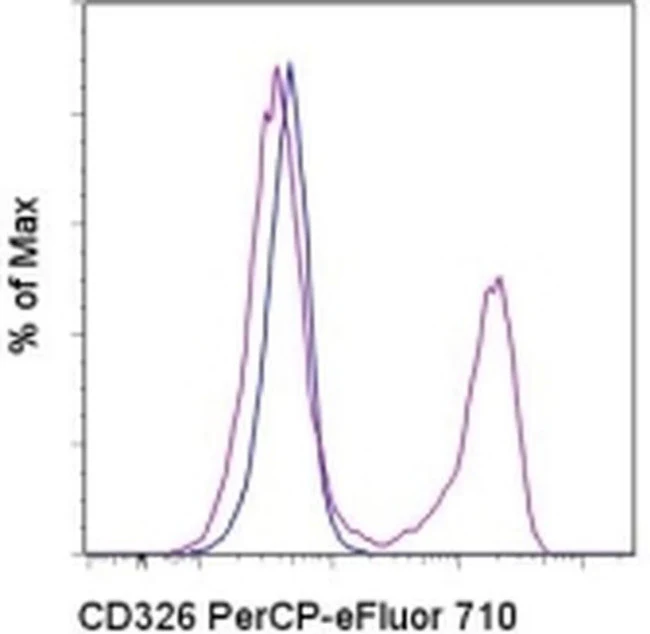
Applications Tested: This G8.8 antibody has been tested by flow cytometric analysis of the TE-71 cell line. This can be used at less than or equal to 0.06 µg per test. A test is defined as the amount (µg) of antibody that will stain a cell sample in a final volume of 100 µL. Cell number should be determined empirically but can range from 10^5 to 10^8 cells/test. It is recommended that the antibody be carefully titrated for optimal performance in the assay of interest.
PerCP-eFluor® 710 can be used in place of PE-Cy5, PE-Cy5.5 or PerCP-Cy5.5. PerCP-eFluor® 710 emits at 710 nm and is excited with the blue laser (488 nm). Please make sure that your instrument is capable of detecting this fluorochrome. For a filter configuration, we recommend using the 685 LP dichroic mirror and 710/40 band pass filter, however the 695/40 band pass filter is an acceptable alternative.
Our testing indicates that PerCP-eFluor® 710 conjugated antibodies are stable when stained samples are exposed to freshly prepared 2% formaldehyde overnight at 4°C, but please evaluate for alternative fixation protocols.
Excitation: 488 nm; Emission: 710 nm; Laser: Blue Laser.
Filtration: 0.2 µm post-manufacturing filtered.
For Research Use Only. Not for use in diagnostic procedures. Not for resale without express authorization.
Product Information
Product Information
Shipping & Returns
Shipping & Returns
CD326 (EpCAM) Monoclonal Antibody (G8.8), PerCP-eFluor 710, eBioscience
CD326 (EpCAM) Monoclonal Antibody (G8.8), PerCP-eFluor 710, eBioscience
PRODUCT DETAILS
Host: Rat
Isotype: IgG2a, kappa
Clonality: Monoclonal
Clone: G8.8
Format: PerCP-eFluor 710
Reactivity: Ms
Application: Flow Cytometry
Tested Dilution: 0.06 µg/test
Concentration: 0.2 mg/mL
Storage: 4°C, store in dark, DO NOT FREEZE!
Formulation: PBS with 0.09% sodium azide; pH 7.2
Purification: Affinity chromatography
Data Sheet: TDS
Specific Information
Description: The G8.8 monoclonal antibody reacts with the 40 kDa protein mouse EpCAM (epithelial cellular adhesion molecule), also known as EGP40 (epithelial glycoprotein 40), 17-1A antigen, TACSTD1 (tumor-associated calcium signal transducer 1), and CD326. The immunogen used to generate the G8.8 antibody was the TE-71 thymic epithelial cell line. CD326 is expressed on the majority of epithelial cells, and is considered a pan-carcinoma antigen. CD326 mediates calcium-independent, homophilic, cell-cell adhesion and may function as a growth factor receptor. The antigen is being used as a target for immunotherapy treatment of human carcinomas. CD326 binds LAIR-1 (CD305) and LAIR-2 (CD306) to inhibit cellular activation and inflammation. This epithelial glycoprotein is now recognized as having an important role in tumor biology.
Applications Reported: This G8.8 antibody has been reported for use in flow cytometric analysis.
Applications Tested: This G8.8 antibody has been tested by flow cytometric analysis of the TE-71 cell line. This can be used at less than or equal to 0.06 µg per test. A test is defined as the amount (µg) of antibody that will stain a cell sample in a final volume of 100 µL. Cell number should be determined empirically but can range from 10^5 to 10^8 cells/test. It is recommended that the antibody be carefully titrated for optimal performance in the assay of interest.
PerCP-eFluor® 710 can be used in place of PE-Cy5, PE-Cy5.5 or PerCP-Cy5.5. PerCP-eFluor® 710 emits at 710 nm and is excited with the blue laser (488 nm). Please make sure that your instrument is capable of detecting this fluorochrome. For a filter configuration, we recommend using the 685 LP dichroic mirror and 710/40 band pass filter, however the 695/40 band pass filter is an acceptable alternative.
Our testing indicates that PerCP-eFluor® 710 conjugated antibodies are stable when stained samples are exposed to freshly prepared 2% formaldehyde overnight at 4°C, but please evaluate for alternative fixation protocols.
Excitation: 488 nm; Emission: 710 nm; Laser: Blue Laser.
Filtration: 0.2 µm post-manufacturing filtered.
For Research Use Only. Not for use in diagnostic procedures. Not for resale without express authorization.
Original: $401.00
-70%$401.00
$120.30Product Information
Product Information
Shipping & Returns
Shipping & Returns
Description
PRODUCT DETAILS
Host: Rat
Isotype: IgG2a, kappa
Clonality: Monoclonal
Clone: G8.8
Format: PerCP-eFluor 710
Reactivity: Ms
Application: Flow Cytometry
Tested Dilution: 0.06 µg/test
Concentration: 0.2 mg/mL
Storage: 4°C, store in dark, DO NOT FREEZE!
Formulation: PBS with 0.09% sodium azide; pH 7.2
Purification: Affinity chromatography
Data Sheet: TDS
Specific Information
Description: The G8.8 monoclonal antibody reacts with the 40 kDa protein mouse EpCAM (epithelial cellular adhesion molecule), also known as EGP40 (epithelial glycoprotein 40), 17-1A antigen, TACSTD1 (tumor-associated calcium signal transducer 1), and CD326. The immunogen used to generate the G8.8 antibody was the TE-71 thymic epithelial cell line. CD326 is expressed on the majority of epithelial cells, and is considered a pan-carcinoma antigen. CD326 mediates calcium-independent, homophilic, cell-cell adhesion and may function as a growth factor receptor. The antigen is being used as a target for immunotherapy treatment of human carcinomas. CD326 binds LAIR-1 (CD305) and LAIR-2 (CD306) to inhibit cellular activation and inflammation. This epithelial glycoprotein is now recognized as having an important role in tumor biology.
Applications Reported: This G8.8 antibody has been reported for use in flow cytometric analysis.
Applications Tested: This G8.8 antibody has been tested by flow cytometric analysis of the TE-71 cell line. This can be used at less than or equal to 0.06 µg per test. A test is defined as the amount (µg) of antibody that will stain a cell sample in a final volume of 100 µL. Cell number should be determined empirically but can range from 10^5 to 10^8 cells/test. It is recommended that the antibody be carefully titrated for optimal performance in the assay of interest.
PerCP-eFluor® 710 can be used in place of PE-Cy5, PE-Cy5.5 or PerCP-Cy5.5. PerCP-eFluor® 710 emits at 710 nm and is excited with the blue laser (488 nm). Please make sure that your instrument is capable of detecting this fluorochrome. For a filter configuration, we recommend using the 685 LP dichroic mirror and 710/40 band pass filter, however the 695/40 band pass filter is an acceptable alternative.
Our testing indicates that PerCP-eFluor® 710 conjugated antibodies are stable when stained samples are exposed to freshly prepared 2% formaldehyde overnight at 4°C, but please evaluate for alternative fixation protocols.
Excitation: 488 nm; Emission: 710 nm; Laser: Blue Laser.
Filtration: 0.2 µm post-manufacturing filtered.
For Research Use Only. Not for use in diagnostic procedures. Not for resale without express authorization.